
Download Our Latest Whitepaper:
Operational and Capital Ecoservice Accounting Standards for Farm Carbon


This photo isn’t just us playing in the dirt. It’s me teaching my grandchildren about soil health and how to observe the land.Why?Because understanding soil health is not only important for farm productivity and landscape function, but also for the future of our farms, our communities and the generations that follow us.
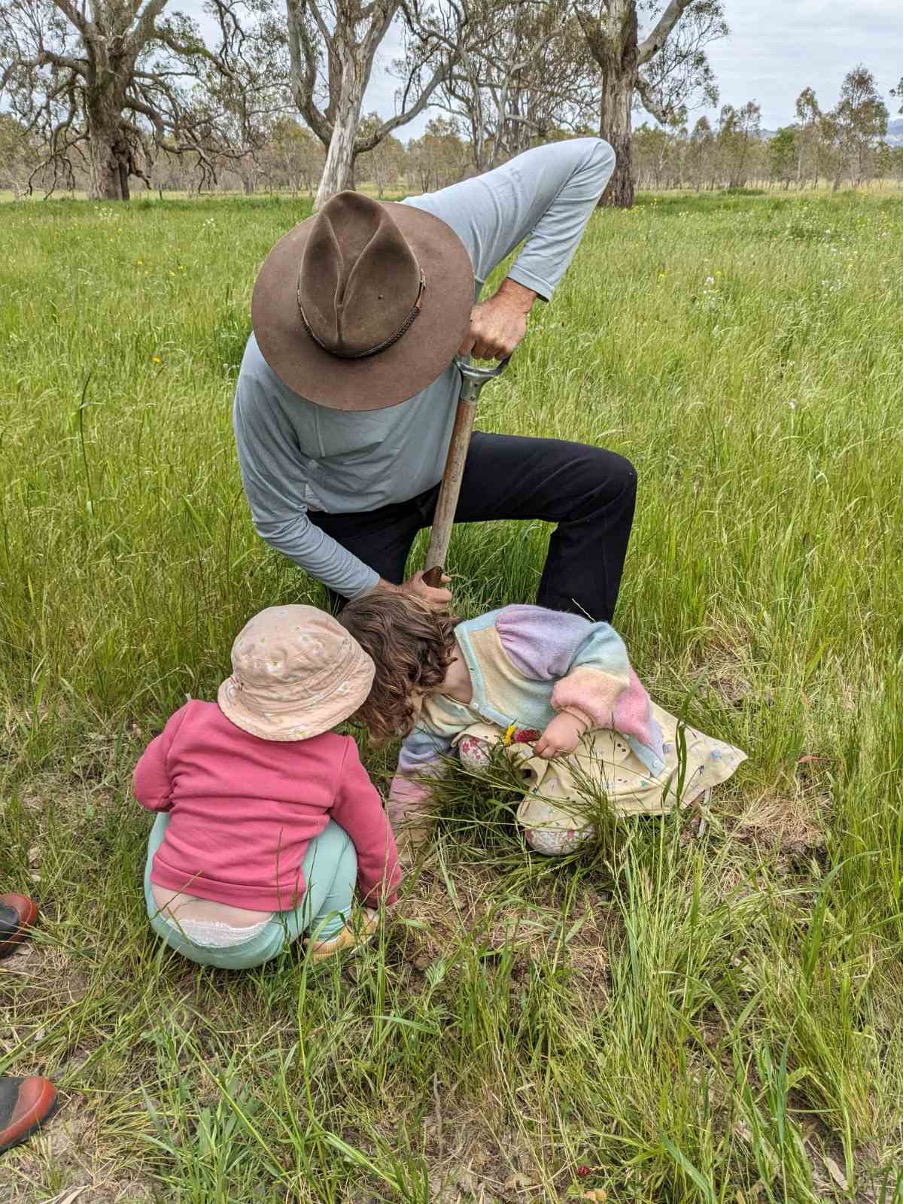

This photo isn’t just us playing in the dirt. It’s me teaching my grandchildren about soil health and how to observe the land.
Why?
Because understanding soil health is not only important for farm productivity and landscape function, but also for the future of our farms, our communities and the generations that follow us. Learning about soil health should be fun, counting the number of wriggle worms and beetles and thinking about why, in some places, they’re more common. Learning should always include using your senses; getting dirty is the wrong description!
Unfortunately, many people use the terms soil quality and soil health as though they mean the same thing and introduce complexity that takes the fun out of learning about soil, which truly is amazing.
Soil quality and soil health are not the same. Learning about soil health can be enjoyed and understood by all.
Soil quality refers to individual characteristics or measurements.
Soil health is broader. It reflects how well the whole soil and landscape system is functioning. And that is where some of the confusion begins, and the fun in soil education is diminished or lost.
Soil health cannot be measured directly in a single test. But it can be assessed through observation, simple in-field measurements and consistent recording over time. It’s about getting your hands dirty, using your eyes, your ears and your strength. In other words, you do not need to rely only on laboratory data or memory. You can build a practical picture of how your soil and landscape are responding.
If you’re trying to improve soil function, reduce reliance on fertiliser, increase hydration or strengthen the performance of your landscape, then you need a way to measure whether change is actually happening. You need to collect data.
Good intentions are not enough.
Many farmers are already making management changes, but without a consistent way to observe and record what is happening, it can be difficult to tell what’s improving, where it’s improving, what is lagging, and where time and money should be directed next.
That is why data matters. It turns observation into useful decision-making. Data is the aggregate of both observation and measurement. Laboratory analysis is a measurement process typically of a soil parameter. Observations typically are a systems response to the environment.
The science of soil health doesn’t start in a laboratory. It starts with paying attention.
When we look closely at soil, plants and landscape function, we notice patterns. Over time, those observations become far more valuable when they’re recorded consistently and compared paddock by paddock.
This is where practical assessment becomes useful. It bridges the gap between instinct (or gut), and evidence.
Over the past decade, I’ve been developing and refining a practical system for assessing soil and landscape function in discussion with, and through trials on, many farms. In the last 3 years, this has been developed into a suite of tests/observations that can be managed through an app.
The goal has been simple: make it possible for farm teams to gather useful information in the field, without needing sophisticated scientific equipment.
This work led to the development of the Soil Processes Observation Tool — SPOT.
SPOT is designed to help users assess and track changes in soil and landscape condition over time using a series of simple DIY tests and observations recorded in the field. It is a mobile app that helps users monitor attributes such as water infiltration, aggregate structure, organic matter penetration and more, while comparing results over time using photos and notes.
The system is app-based for ease of record retrieval. The SPOT App records observations and simple measurements using a rating system of 1 to 5.
A series of in-field observations and tests are undertaken to assess physical and chemical soil health attributes, with four assessments in each category. These quarterly test scores are added together to give a total score out of 20.
Separately, landscape and biology are assessed annually, again using four tests rated out of 5, giving a second total out of 20.
At 20/20, you have full soil and landscape health — perfect vision — to maximise hydration and landscape productivity.
If the first score is less than 20, there is still work to do in soil health. If the second score is less than 20, there is further work to do across both the soil and the broader landscape system to achieve a healthy landscape.
If you would like to start using SPOT to record and track change on your own property, you can sign up here: [Sign up for SPOT]
If you would like to explore these ideas in practice, the next Landscape Rehydration, Soil Health & SPOT Check Workshop will be held at Deans Marsh, Victoria, on 21 April 2026, (the day before the Grounded Festival).
The workshop will cover topics including runoff, reading your land, infiltration, plant available water, soil improvement and the “two levers of profit,” with practical skills in using simple measurement tools to assess current soil condition and track improvement over time.
The session runs from 8:30am to 2:45pm at Deans Marsh Community Hall, and the ticket includes lunch, a pH kit, the Carbon Farming Handbook and access to the SPOT app.
To secure your place, get your tickers here: https://events.humanitix.com/deans-marsh-workshop

Sign up to the Ryzo Newsletter and discover how you can improve farm production whilst benefiting from the new income stream the carbon trading market has to offer.


